

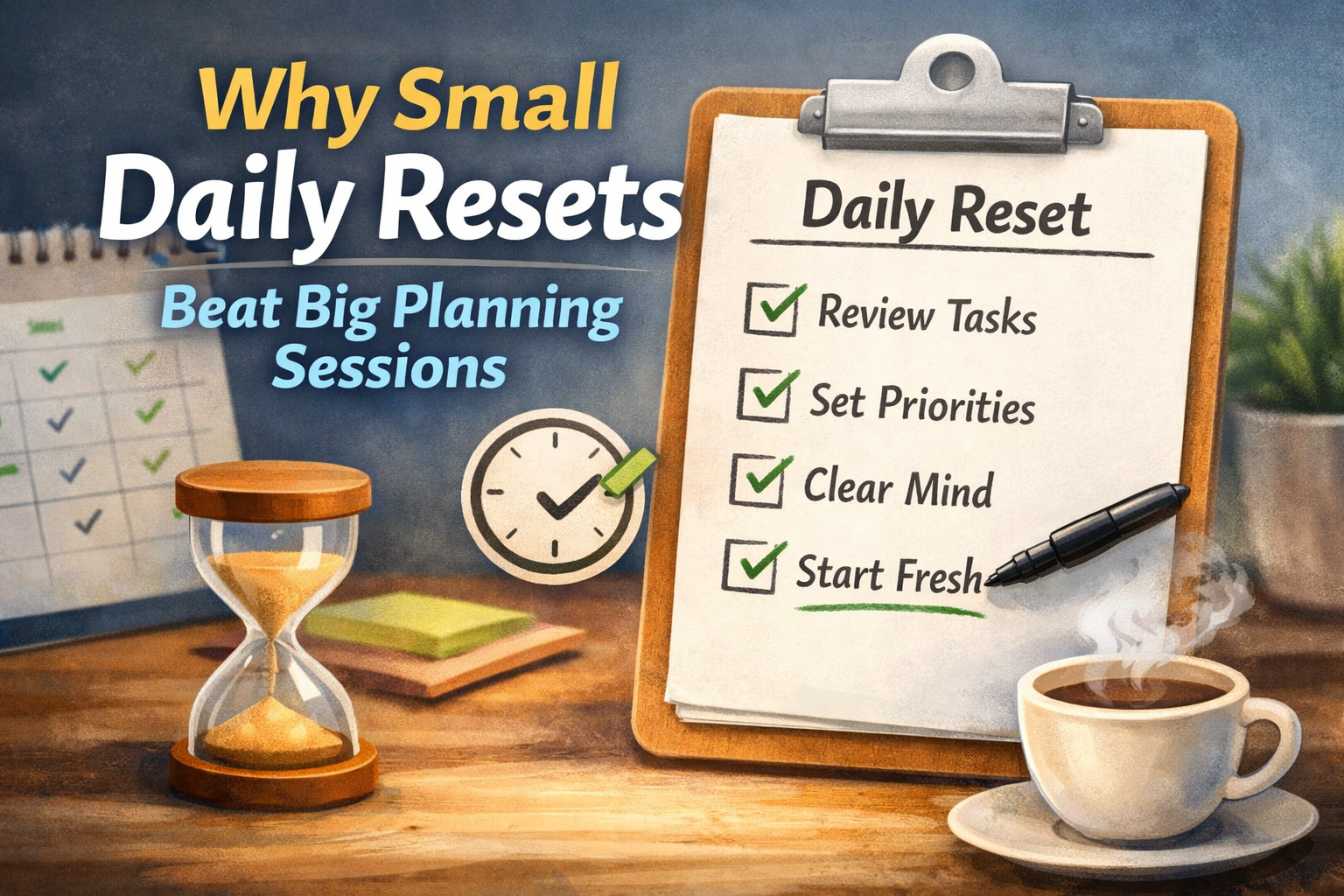
Many people rely on long weekly or monthly planning sessions to get organized. These sessions feel productive because everything looks clean, prioritized, and under control. The problem is that reality changes fast. New tasks appear, priorities shift, and energy levels fluctuate. A plan made days ago can quickly become outdated, leaving you frustrated or avoiding the system entirely.
What is a daily reset?
A daily reset is a short, intentional moment—usually 5 to 10 minutes—where you review your tasks, clear mental clutter, and decide what actually matters today. Instead of re-planning your entire life, you make small adjustments that reflect current priorities. This keeps your task list honest and usable.
Why daily resets work better
Daily resets reduce cognitive overload. When your task list matches reality, your brain trusts it more. You spend less time deciding what to work on and more time doing the work itself. These resets also create a sense of closure. Even unfinished tasks are acknowledged, which lowers background stress.
People often ask, “Isn’t daily planning redundant if I already plan weekly?” The answer is no. Weekly planning sets direction. Daily resets handle execution. One without the other leads to either chaos or rigidity.
What should a daily reset include?
A simple daily reset usually covers four steps:
- Review what you completed yesterday
- Remove or defer tasks that no longer matter
- Select 1–3 priorities for today
- Break any vague task into a clear next action
How long should a daily reset take?
A common question is, “How much time should I spend resetting my tasks?” Ideally, less than ten minutes. If it takes longer, the system may be too complex. The goal is momentum, not perfection. A fast reset done consistently beats an elaborate system used once a week.
Daily resets and motivation
Daily resets create quick wins. Choosing realistic priorities makes completion more likely, and completion fuels motivation. Over time, this builds trust in your task manager. You stop feeling like your system is judging you and start feeling like it’s supporting you.
Another frequent question is, “What if I don’t finish my top tasks?” That’s exactly why resets work. You revisit them the next day, reassess their importance, and adjust without guilt. Progress becomes adaptive instead of all-or-nothing.
Turning resets into a habit
Attach your daily reset to an existing routine, such as starting work, finishing lunch, or closing your laptop for the day. Consistency matters more than timing. Once the habit forms, planning stops feeling like work and starts feeling like clarity.
In task management, small actions done daily often outperform big efforts done occasionally. A simple daily reset can be the difference between a task list that overwhelms you and one that actually helps you move forward.
